


It is not an AI just because you tell the EPO it is: Vesuvius v. Refractory (T 1669/21)

The decision in opposition case T 1669/21 Vesuvius v. Refractory of 23 July 2024 relates to European Patent EP 2789960 B1 (first application with filing date 12.04.2013).
The patented invention is, interestingly, not situated in the field of AI at all. Instead, it relates to the field of metallurgy, in particular in monitoring a melting vessel for molten metals. It relates to a method of determining the state of a refractory lining of such a vessel based on data measured during use, e.g. temperature, and stored data, e.g. material properties.
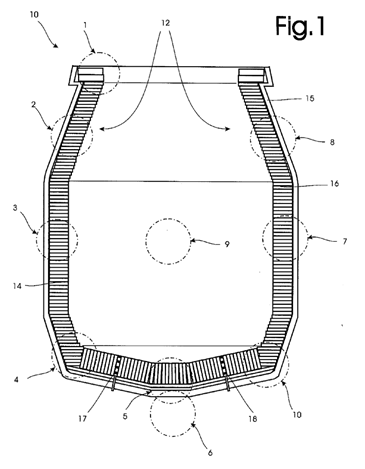
Claim 1 according to the main request in appeal proceedings reads as follows:
A method for determining the state of the refractory lining of a vessel containing the molten metal, wherein data of this refractory lining (12), such as materials, wall thickness, type of installation and others are detected or measured and evaluated,
characterised in that
the following measured or established data of each vessel (10) are all collected and stored in a data structure, namely
the initial refractory construction of the inner vessel lining (12), such as materials, material properties, wall thicknesses of blocks and/or injected materials as maintenance data;
production data during use, such as amount of molten mass, temperature, composition of the molten mass or the slag and its thickness, tapping times, temperature profiles, treatment times and/or metallurgical parameters;
wall thicknesses of the lining after using a vessel (10), at least at points with the greatest degree of wear;
additional process parameters such as the manner of pouring or tapping the molten metal into or out of the vessel (10);
that a calculation model is generated from at least some of the measured or ascertained data or parameters of the maintenance data, the production data, the wall thicknesses and the process parameters, by means of which these data or parameters are evaluated by means of calculations and subsequent analyses,
wherein the calculation model is adapted based on the measurements of the wall thicknesses of the lining after a number of tappings,
whereby the wear is calculated based on the collected and structured data.
The description did not provide even one example of how a calculation model is to be determined, let alone any plausible explanation of how the claimed method allowed determining the state of the lining. Therefore, the Opposition Division revoked the patent for lack of sufficiency.
The proprietor appealed and argued that a neural network is implicit in the claimed calculation model, and that the skilled person was able, at the patent's priority date (in 2013) to set up a neural network.
However, the application was not drafted as an AI application and did not contain any reference to AI, neural networks, machine learning, training data, or any related explanation beyond a brief mention of a neural network in a somewhat unclear sub-claim.
Consequently, the Board did not follow the proprietor's view and dismissed the appeal.
Comment
The decision makes sense. If the arguments of the proprietor had been accepted, basically any application claiming any calculation lacking sufficient disclosure could be saved by the argument that any AI could do that, which is known to be wrong.
The USPTO had similar reservations against the claimed model. In parallel US proceedings (14/777,810), the application was rejected based on, among other things, failure to comply with the written description requirement (35 U.S. Code § 112) since the description did not contain any details about the model (office action dated 7 December 2017).
However, the proprietor’s representative has a point in stating that the knowledge of the skilled person changes quickly due to the rapid progress in the field of machine learning.