


It is not enough to say an AI can do it, even if you say it in the description: Performance monitoring – Inetco Systems (T 1539/20)

Decision T 1539/20 Performance monitoring – Inetco Systems of 24 November 2022 relates to application EP 2732581 A1 (priority date 15.07.2011).
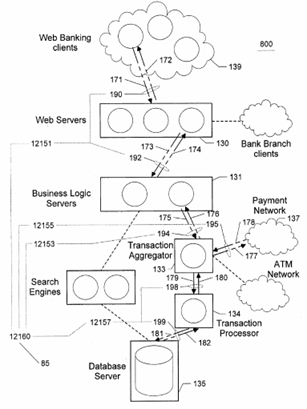
The application does not claim an AI, but relates to monitoring the performance of a computing system which is distributed across network-connected nodes. In particular, an aim is monitoring the real-time behaviour and performance of applications that are distributed across multiple network-connected nodes with respect to meaningful data messages passed between the nodes. In some cases, such messages can be monitored only by monitoring the network itself. To obtain a higher-level understanding of application performance, the (lower-level) data messages passed between nodes over the network then have to be “correlated” into (higher-level / application-level) transactions.
The application focuses on the process of correlating lower-level data messages into higher-level transactions.
The Examining Division refused the application based on lack of clarity and added subject-matter objections. The applicant appealed. The Board dismissed the appeal based on lack of clarity and sufficient disclosure.
Claim 1 according to the main request in appeal proceedings reads as follows:
A method for monitoring performance of an application system (800) which is distributed across a plurality of network connected nodes (110), comprising:
using a processor, monitoring network traffic between the plurality of network connected nodes (110) of the application system (800) to gather network traffic data; and
assembling the network traffic data into messages (171);
characterised by:
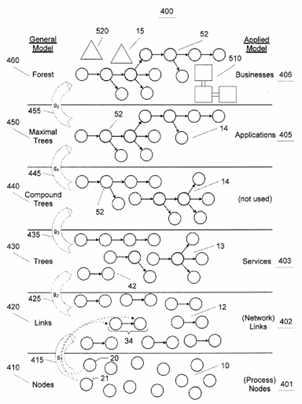
mapping the application system (800) onto a hierarchical model (400) for the application system (800) according to a network topology (810) of the application system (800), the hierarchical model (400) having a plurality of levels (420), each level (420) including components (34) having a span of network connected nodes specific to that level (420), the plurality of levels (420) extending across the network topology (810);
correlating the messages (171) into sets of one or more messages that are causally associated in accordance with the hierarchical model (400), wherein the sets of causally associated messages constitute transactions (190) corresponding to a lowest level (420) of the hierarchical model (400), the components (34) of the lowest level (420) having two network connected nodes (110); wherein the correlating of the messages (171) includes at least one of: a rule-based comparison of attributes between messages (171) that yields an exact match; and, a probabilistic association between the messages (171) based on one or more of contents of the message payloads, contents of the message headers, timing of the messages, and sequence of the messages; and
generating records of individual transactions (190) occurring within the application system (800) for at least the transactions (190) corresponding to the lowest level (420) of the hierarchical model (400) and applying one or more metrics (1510) of performance thereto.
The sufficiency of disclosure objections by the board relate to the mapping step underlined above:
- Concerning the claimed levels, para. 39 of the description mentions a lowest level comprising “selected nodes” without specifying how the nodes are selected.
- Paragraph 42 states that the selection of the subsets of links forming trees at level 430 also depends on the details of the distributed application system. However, there is no explanation of what the relevant details are and how the computer implementing the method can obtain this information.
- Concerning the mapping step, para. 77 states that defining the services from the link classes depends on how the IT system has been implemented by developers and system integrators, and how it is operated. The Board considered it impossible for the skilled person to implement this in software.
- The correlations between transactions of different levels are described as defined either by a human user or an automated learning system, para. 87. The Board considered the automated learning system not sufficiently described, in particular since no data are disclosed on which the system can be trained.
Comment:
The decision is a telling example of what mistakes to avoid when drafting a description. The terms used in the description should be consistent with the claims, rather than introducing new terms without properly defining them (selected nodes). Moreover, statements of the kind “Defining the services from the link classes depends on how the IT system 800 has been implemented by developers and system integrators, and how it is operated“ should be avoided. They make the EPO examiner suspicious since they seem to indicate that the invention cannot be put into practice without the developers and system integrators inventing something on top of what is described. This holds in particular in case of a computer-implemented invention, where every claimed step must be such that it can be done by a computer program, and the description must give a sufficiently detailed description of the program or indicate a well-known algorithm that can be used.
The objections (in particular that about the learning system) seem reasonable as far as they relate to parts of the description, but the Board does not explain for all of the description parts how they relate to the claims or why the passages objected to would have to be worded differently to achieve sufficient disclosure.
The application does not relate to machine learning beyond two sentences in para. 87 of the description: “[T]he knowledge may be discovered by automated learning systems that are parameterized with pre-defined models of various kinds of IT systems, application types, and topologies. Or learning may be derived in an unparameterized approach that identifies unique, previously unknown behaviors of interest”. The Board seems correct in stating that this passage does not sufficiently disclose the workings of the learning system. However, the actual problem does not seem to be the lack of training data, but rather the entirely functional language. A model is a piece of information that describes something, and could be implemented in many ways.
Behaviours of interest are behaviours to which the user of the system ascribes a semantic meaning, but not functional data. This is why it is fair to say that the learning system is not sufficiently disclosed here.
In parallel proceedings, US patent US8732302B2 was granted with similar claims, and enablement was not seen as problematic.