


You should train the AI, not the athlete: Running performance – SHFT (T 1079/17)

DDecision T 1079/17 Running performance – SHFT of 3 December 2021 relates to application EP 2889853 A1 (first filing with application date 27.12.2013).
The application relates to a portable device comprising accelerometers configured to measure movement of a runner’s feet. The device compares the measured movement to an optimal movement pattern and then provides feedback to the user on how to improve running performance.
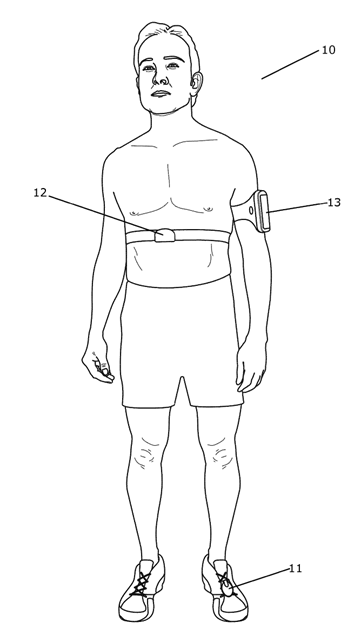
Claim 1 according to the main request in appeal proceedings reads as follows:
- A method for optimizing running performance for an individual (10) during a training pass in order to minimize the risk of injury, the method comprising the steps of:
(a) continuously monitoring movements of a foot of the individual (10) in real time during running, using one or more accelerometers arranged at or near the foot of the individual,
(b) transmitting data obtained during the monitoring step from the one or more accelerometers (11) to a portable electronic processing device (13),
(c) the portable electronic processing device (13) deriving a three-dimensional movement pattern of the foot of the individual during an impact phase of a stride in real time by deriving points of impact and duration of impact on the foot between the foot and the ground during an impact phase of a stride, monitoring points of impact between the foot and the ground, monitoring duration of impact between the foot and the ground, based on the information regarding the speed, position and impact time of the foot, during the impact phase of a stride obtained by the accelerometers during the monitoring step,
(d) the portable electronic processing device (13) continuously comparing the derived movement pattern of the foot of the individual during an impact phase of a stride in real time to an optimal movement pattern, said optimal movement pattern being a pattern that is known to minimize the risk of injuries, and
(e) the portable electronic processing device (13) providing audible feedback in real time repeatedly during the entire running pass to the individual, based on the comparing step, and in order to adjust the movement pattern of the foot of the individual in the direction of the optimal movement pattern, thereby improving a running performance in order to minimize the risk of injury.
The novelty over the closest prior art (D1, US 2008/0190202 A1) was that the optimal movement pattern is known to minimize the risk of injuries, and that feedback is given to the user. The Examining Division did not find any technical effect in these features and thus refused the application as obvious over D1.
The applicant appealed. In a communication ahead of the scheduled oral proceedings, the Board of Appeal was even more critical about inventive step starting from D1, noting that D1 did discuss health issues and thus hinted towards the claimed solution. The Board also raised concerns about sufficiency of disclosure.
In its decision, the Board dismissed the appeal based only on the question of sufficiency of disclosure. Regarding the specific parameters (maximum impact force, ground contact duration, foot imprint characteristics, and magnitude and/or position of an impact) the Board did not find any details in the description, e.g. typical values, let alone optimal values for avoiding risks of injuries.
Moreover, the Board concluded that the optimal movement pattern (i.e. the benchmark to which the measured movement is compared) was not defined in further detail. The description (see EP2889853A1 para. 37) suggested collecting data from a plurality of training passes, in order to improve the system “to reflect a running style which is truly optimal, based on actual measurements performed on actual runners performing actual training passes”. The Board considered that the description lacked the necessary level of detail on values of quantities derived from the acceleration data.
Even more interestingly, the description suggested that the „improved optimal movement patterns may, e.g., be obtained by means of artificial intelligence (AI), e.g. using pattern recognition and classification of running styles“. However, the application did not contain any more specifics, e.g. structure or training also of the AI (it related only to the training of the athlete). The Board stated that the application did not describe how precisely such values might be obtained using artificial intelligence.
Comment
This case is a good example for efficient drafting of decisions. The Board needed one ground for refusal, picked sufficiency, and explained it correctly.
Concerning sufficiency of disclosure, the claims set quite a high bar to which the description had to be measured. Since a claimed technical effect was “improving a running performance in order to minimize the risk of injury”, the application could be expected to contain medical data defining a running pattern that minimized the risk of injury. The superlative claim language (the object to “minimize”, not only reduce risk) is even more ambitious.
The key takeaway when it comes to AI drafting is that a brief mention of the possibility of using an AI for pattern recognition and classification to process data is not particularly helpful to overcome a lack of sufficiency objection. In this case, the input data to the AI were not shown to contain the necessary information, and it was not pointed out how the AI could have solved this problem.